
From opportunity to application
Useful AI starts
with a specific problem.
A place to start the conversation: the problems we help address, what an engagement can deliver and how we would assess the result.
Illustrative solution briefs. Scope and measures are agreed for each engagement.

Make company knowledge accessible.
Teams spend time searching across documents, systems and conversations. Answers are difficult to verify, and access rules still need to apply.
Related expertiseThe approach
Start with approved sources and a measured retrieval baseline. Add GraphRAG for connected knowledge or agentic retrieval for multi-step questions where evaluation supports it. Preserve permissions, citations and freshness throughout.
What we deliver
- Source and access model
- Retrieval architecture and assistant interface
- Retrieval and answer evaluation set
How we assess success
Source coverage, retrieval relevance, citation accuracy, useful-answer rate and time to find information.

Move work forward with agents.
A service request may cross several systems and require judgement at each step. Manual handoffs lose context, while unrestricted automation creates new problems.
Related expertiseThe approach
Map the process into explicit states and route requests by intent. Connect CRM, support or ERP tools through scoped APIs and MCP. Add persistent task state, validated inputs, recovery paths and human approval where it matters.
What we deliver
- Workflow and authority map
- API and MCP integrations
- Approval, recovery and audit paths
How we assess success
Task completion, correct tool use, handling time, recovery success and the quality of escalations.
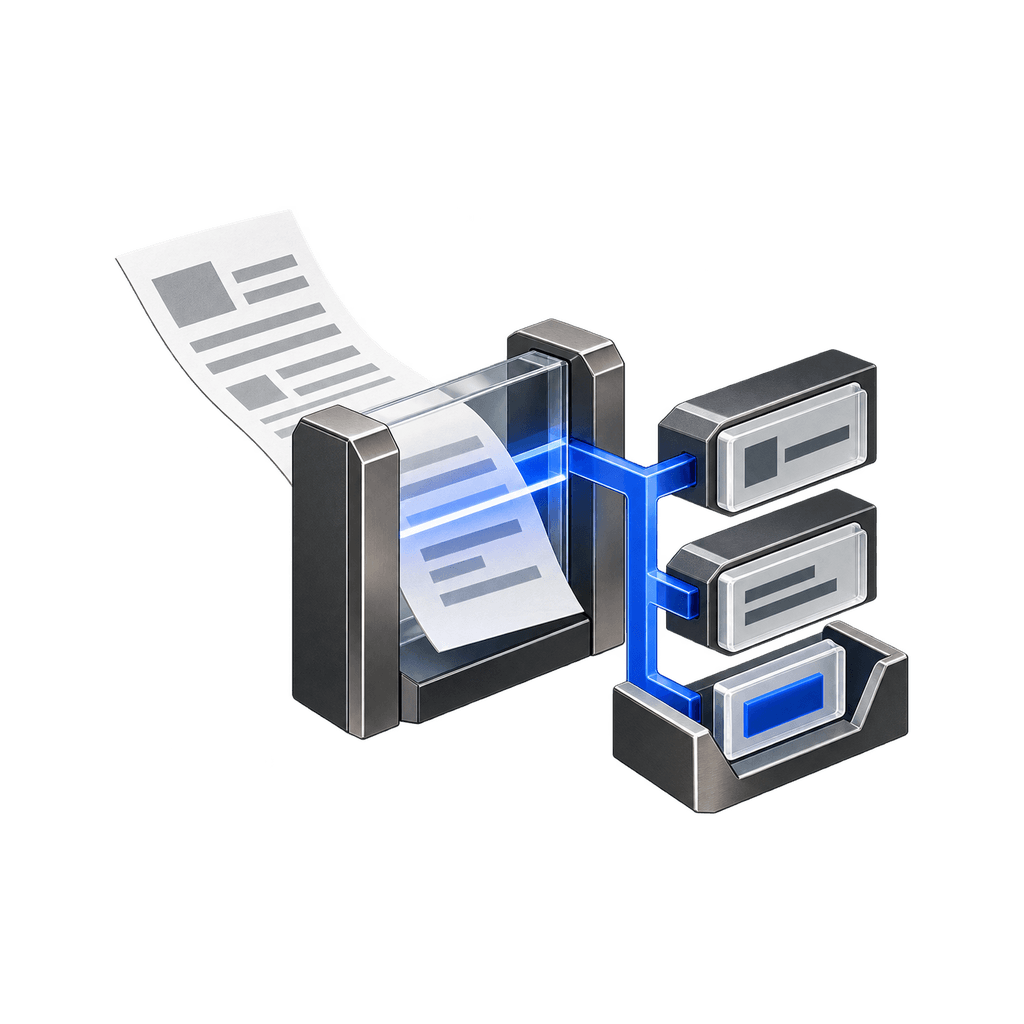
Turn documents into usable data.
Important information arrives in inconsistent formats. Copying it between systems is slow, and mistakes are difficult to trace back to the source.
Related expertiseThe approach
Combine document parsing, OCR and multimodal models with schema validation and source references. Route uncertain or conflicting fields to a review interface before downstream processing.
What we deliver
- Ingestion and extraction pipeline
- Validation rules and review queue
- Integration with downstream systems
How we assess success
Field-level accuracy, document coverage, correction effort, processing time and cost per accepted document.

Make AI quality a release decision.
A convincing demo says little about how a system behaves across real tasks. Model and prompt changes can quietly introduce regressions.
Related expertiseThe approach
Build representative datasets and explicit scoring rubrics. Combine deterministic checks, LLM-as-judge and expert review. Calibrate judges, compare versions and feed production failures back into the test set.
What we deliver
- Evaluation datasets and scoring rubrics
- Calibrated judges and regression checks
- Release criteria and quality reporting
How we assess success
Task success, judge agreement with reviewers, regression rate, failure coverage and quality by user segment.

Build a shared foundation for AI.
Separate experiments accumulate different provider integrations, prompts and monitoring. Costs and behaviour become harder to understand as adoption grows.
Related expertiseThe approach
Create shared model access with semantic routing, provider fallbacks and usage budgets. Add tracing, versioned prompts and permission-aware semantic caching. Connect MLOps and LLMOps practices to evaluation and controlled releases.
What we deliver
- Model gateway and service interfaces
- Tracing, cost controls and dashboards
- Deployment and operational runbooks
How we assess success
Routing correctness, cost per completed task, p95 latency, availability, incorrect cache reuse and time to release safely.

Build the product around the capability.
A useful model still needs a product: clear interactions, reliable data, integrations, access controls and a delivery process the team can own.
Related expertiseThe approach
Design the user journey alongside the architecture. Build the application, APIs and data services in working increments, with automated tests and a practical path from prototype to production.
What we deliver
- Product and architecture decisions
- Application, APIs and integrations
- Automated delivery and team handover
How we assess success
User task completion, adoption, reliability, support burden and the time needed to make a change.

Take AI from prototype to production.
A prototype may work with one user and a small dataset, yet still lack the deployment controls, capacity planning and data boundaries required for everyday use.
Related expertiseThe approach
Design a deployment on AWS, Google Cloud or Azure around the workload and existing estate. Compare managed services with private or container hosting, then automate environments, identity, monitoring and recovery.
What we deliver
- Cloud architecture and service decisions
- Infrastructure as code and deployment pipelines
- Capacity, cost and operational runbooks
How we assess success
Availability, recovery time, deployment reliability, infrastructure cost and performance under representative load.

Make better use of operational data.
Teams need to prioritise work, anticipate demand or identify unusual behaviour. Reports describe what happened, but provide limited help with the next decision.
Related expertiseThe approach
Define the decision and the cost of mistakes, establish a simple baseline and compare suitable predictive models. Validate on unseen data and realistic time periods, then bring predictions into the workflow with monitoring and human review.
What we deliver
- Data assessment and benchmark baseline
- Prediction service and workflow integration
- Performance monitoring and retraining criteria
How we assess success
Forecast error, precision and recall, calibration, adoption and the effect on the decision the model supports.
Not sure where
to begin?
Start with the decision you need to make.
We can assess the opportunity, review your data and architecture, and define a useful first step. You leave with a reasoned view of what to build, what to buy and what to test.
Explore AI strategy